
How Facial Recognition Door Entry Works: A Plain Guide

Walking up to a door and having it recognize you, with nothing to tap or remember, feels like the future arriving at the entrance. But how does facial recognition door entry actually work, and can it tell a real face from a photo held up to the camera? This plain-language guide explains the technology, the safeguards that stop spoofing, and where biometric entry genuinely fits, without hype.
We install face-capable entry systems across New York, so the goal here is an honest, practical explanation of what the technology does well and where its limits are.
In short, facial recognition door entry enrolls a resident’s face as a mathematical template, then compares the face at the door against that template to grant or deny entry in about 1 second. Liveness detection and anti-spoofing features confirm it is a real, present person rather than a photo or screen.
This article is general educational information about how the technology works. It is not legal or medical advice, and biometric data is regulated differently across places, so confirm the rules that apply to your building before deploying face entry.
What facial recognition door entry is
Facial recognition door entry is a form of biometric entry that uses a person’s face as their credential. Instead of a card or code, the resident simply presents their face to a panel at the door.
The defining idea is that the system does not store a photograph in the way people imagine. It converts the face into a numerical template — a set of measurements describing facial features — and uses that template to recognize the person later. Because the credential is the face itself, there is nothing to carry, lose, share, or steal, which is both the core appeal and the reason it deserves careful handling.
This template-based approach is also why the technology can work quickly and at scale. Comparing compact numerical templates is fast for a computer, which is how a panel can recognize a resident in about a second. It is a very different thing from a human scanning a wall of photographs, and understanding that distinction helps demystify what the system is really doing.
How facial recognition door entry works, step by step
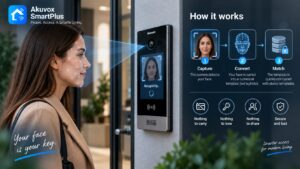
The process has two phases: a one-time enrollment and then the everyday recognition at the door. Both are quick.
- Enrollment: The resident’s face is captured once and converted into a stored template, the reference the system will match against.
- Capture: At the door, the panel’s camera detects a face and captures it in real time.
- Conversion: That live face is turned into a template using the same method as enrollment.
- Matching: The system compares the live template to the stored one and scores how closely they align.
- Decision: If the match score passes the threshold, the door releases; if not, entry is denied, all in about 1 second.
Telling a real face from a photo: liveness detection
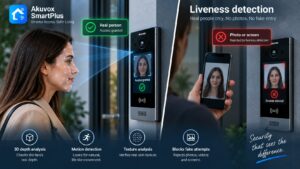
The obvious question is whether someone could fool the system with a photo, and the answer lies in liveness detection. This is the feature that confirms a real, living person is present.
Liveness detection looks for signs that the face at the door is three-dimensional and genuinely there, rather than a flat image. Techniques analyze depth across 3 dimensions, subtle motion, and texture that a printed photo or a face on a 2-dimensional phone screen cannot reproduce convincingly. A capable system will reject a held-up picture because it fails these checks, which is what makes face entry trustworthy enough to secure a door rather than a novelty.
Anti-spoofing techniques
Beyond basic liveness, modern systems layer additional anti-spoofing defenses to resist more determined fakes. The goal is to defeat photos, videos, and masks alike.
- Depth sensing: Reading the face in 3 dimensions distinguishes a real, contoured face from a flat photo or screen.
- Texture analysis: The system examines skin texture and reflections that printed or displayed images render differently.
- Infrared imaging: Some panels use infrared to confirm a genuine face under varied lighting and to defeat screen-based fakes.
- Motion cues: Natural micro-movements help confirm a live subject rather than a static image.
Accuracy and speed
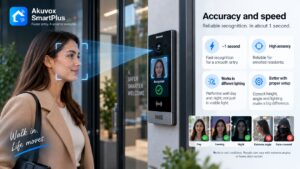
For a door, two things matter day to day: does it recognize the right people reliably, and is it fast. Modern systems perform well on both.
A good face panel matches an enrolled resident in roughly 1 second, fast enough that residents barely break stride, and it does so across a wide range of lighting because it does not depend on visible light alone. Accuracy is high for enrolled faces, though performance can vary with extreme angles, heavy obstruction, or poor positioning, which is why thoughtful camera placement matters. The practical experience for a resident who is properly enrolled is to walk up and have the door simply open.
Reliability in the real world depends heavily on installation. A panel mounted at a sensible height, aimed to capture faces straight on, and shielded from harsh backlighting will perform far better than one placed as an afterthought. Much of the difference between a face system residents love and one they fight with comes down to thoughtful setup rather than the hardware itself.
Privacy and data handling
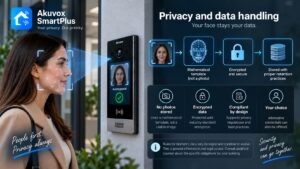
Because the credential is a person’s face, privacy is a serious and legitimate consideration, not an afterthought. How the data is handled is central to doing this responsibly.
Reputable systems store the mathematical template rather than usable photographs, and that data should be protected with encryption and sensible retention practices. Just as important, the rules governing biometric data differ significantly from place to place, and they continue to evolve. A building considering face entry should understand what it is collecting, where it is stored, and what local requirements apply, ideally offering residents alternative credentials as well. Again, this is general information and not legal advice; consult qualified counsel about the specific obligations for your building.
Where it fits in a building
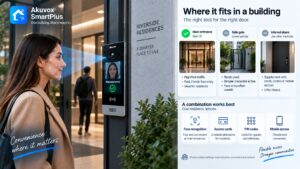
Face entry is powerful, but it is not the right tool for every door. It shines in specific places and is overkill in others.
The strongest fit is a busy main entrance where speed and a hands-free experience matter and residents pass through constantly. It is less necessary at a rarely used side gate, where a simpler credential is fine. Buildings that deploy it well typically use face entry at the primary door and pair it with cards, codes, or mobile access elsewhere, offering residents choice rather than forcing one method everywhere. Used that way, it adds convenience exactly where it pays off.
Offering a choice of credentials also makes the system more inclusive and resilient. Not every resident will want to enroll their face, and not every situation suits it, so a building that pairs face entry with cards, codes, or mobile access ensures everyone has a comfortable way in. That flexibility, rather than insisting on one method, is the hallmark of a well-planned deployment.
Strengths and limits
An honest summary helps set expectations. Face entry has clear advantages and real caveats.
- Strength, nothing to carry: The credential cannot be lost, shared, or left at home, because it is the resident.
- Strength, fast and hands-free: Entry in about 1 second with no fumbling for a card or phone.
- Limit, privacy and rules: Biometric data demands careful handling and attention to evolving regulations.
- Limit, conditions matter: Extreme angles, obstruction, or poor placement can affect recognition, so setup matters.
Frequently asked questions
How does facial recognition door entry work?
It enrolls a face as a mathematical template, then compares the live face at the door to that template and releases the door if they match, in about 1 second.
Can a photo fool facial recognition?
A capable system rejects photos through liveness detection and anti-spoofing, which check for depth across 3 dimensions, texture, and motion that a flat image cannot reproduce.
What is liveness detection?
It is the safeguard that confirms a real, present, three-dimensional person is at the door rather than a printed photo or a face shown on a screen.
Does the system store my photo?
Reputable systems store a numerical template of facial measurements rather than a usable photograph, and that data should be encrypted and handled responsibly.
Is facial recognition entry secure enough for a building?
With strong liveness and anti-spoofing, yes for the right doors, though privacy handling and local rules must be addressed, and alternative credentials should be offered.
Curious whether face entry fits your building? We will give you a straight assessment. See the face-panel X915 and door station R29, learn about our access control service, or ask us how it works.
Related Articles