
Access control system for apartment buildings in Queens
Managing access in an apartment building is different from controlling a small office or private property. Residents need convenient entry every day, while property managers must also control access for visitors, contractors, maintenance staff, and deliveries.

Customized Security Solutions
We design tailored intercom and access control systems based on your property's unique requirements, ensuring the right fit for every project.

Professional Installation
Our experienced technicians handle every stage of the installation process, delivering reliable performance and attention to detail.

Advanced Technology
We provide modern, feature-rich solutions with cloud management, mobile access, and seamless integration capabilities.

Ongoing Support & Maintenance
From system setup to long-term service, our team is committed to keeping your security solutions operating efficiently.
An electronic access system can assign different permissions to residents and building staff, control common areas, manage parking entrances, and disable credentials when a tenant moves out. Depending on the configuration, it can also work with an intercom, door locks, garage gates, and other building systems.
For property owners and managers considering apartment building access control systems in Queens, the first step is to map the building’s entrances, common areas, resident access requirements, and existing door hardware.
Why Apartment Buildings Need Controlled Access
A multi-tenant property has a constantly changing group of people who need access to different areas.
Traditional keys can create administrative problems when:
- A resident loses a key.
- A tenant moves out.
- A contractor needs temporary access.
- Staff members change responsibilities.
- Visitors need controlled entry.
- Several people require access to common areas.
With electronic access control, permissions can be modified without replacing a complete set of locks.
For example, a former tenant’s credential can be disabled while other residents continue using their existing credentials. A maintenance worker can receive access to service areas without automatically receiving permission to enter every part of the building.
The objective is to make everyday entry convenient for residents while giving property management greater control over who can access specific areas.
Access Points in an Apartment Building
An apartment building may have many controlled points, and each one can have different access requirements.
- Main Building Entrance. The primary entrance normally serves residents, visitors, and deliveries. Residents can use their assigned credentials, while visitors can be handled through an intercom, reception, or another approved process.
- Side or Rear Entrance. A secondary entrance can be limited to residents, staff, or authorized users.
- Garage and Parking. Vehicle entrances may require separate access rules from pedestrian doors.
- Amenity Areas. Gyms, lounges, rooftops, pools, and other common spaces can be restricted to residents or specific user groups.
- Service Areas. Maintenance rooms, storage spaces, utility rooms, and other restricted areas can have access limited to authorized staff.
This allows property management to create a separate permission structure for each part of the building rather than giving every user unrestricted access.
How Residents Enter the Building
Residents can use different types of credentials depending on the selected system.
Common options include:
- Key fobs.
- Access cards.
- PIN codes.
- Mobile credentials.
- Other supported authentication methods.
A typical process is:
Resident → credential → reader → authorization → door unlocks
The resident does not need to interact with building management for every entry. Once the appropriate permissions have been configured, authorized access can happen automatically.
Different entrances can also have different rules. A resident might have access to the lobby, assigned parking area, and gym while having no authorization for maintenance rooms or management offices.
For properties that need to coordinate access for many tenants, apartment access control systems in Queens can provide centralized management of individual credentials and permissions.
Managing Tenant Access
Tenant management is one of the most important functions of an apartment building access system.
The access lifecycle can be organized as:
Move-in → credential issued → access assigned → permissions modified → move-out → access revoked
When a new resident moves in, management can issue a credential and assign the required access group.
If the resident loses a fob, that credential can be disabled and replaced rather than changing the locks throughout the property.
When a tenant moves out, their access can be removed without affecting the credentials of other residents.
Management can also adjust permissions when residents receive access to additional amenities, parking spaces, storage areas, or other controlled locations.
Access Control for Building Staff and Contractors
Building staff do not necessarily need the same permissions as residents.
Access groups can be created according to job responsibilities.
- Property Managers. May require access to management areas, common spaces, and other operational locations.
- Maintenance Staff. May need access to utility rooms, service entrances, mechanical areas, and selected common spaces.
- Cleaning Staff. Can receive access to designated areas during scheduled working hours.
- Security Personnel. May require broader access to entrances and restricted areas.
- Contractors. Can receive temporary permissions for specific locations and time periods.
For example:
Maintenance → service entrance + mechanical room
while:
Cleaning staff → designated common areas during scheduled hours
This reduces unnecessary access while allowing staff to perform their duties.
Guest and Visitor Access
Visitors should be able to reach residents without receiving the same permanent access rights as tenants.
A building can use several visitor workflows depending on its configuration:
- Resident-approved entry.
- Intercom verification.
- Reception-controlled access.
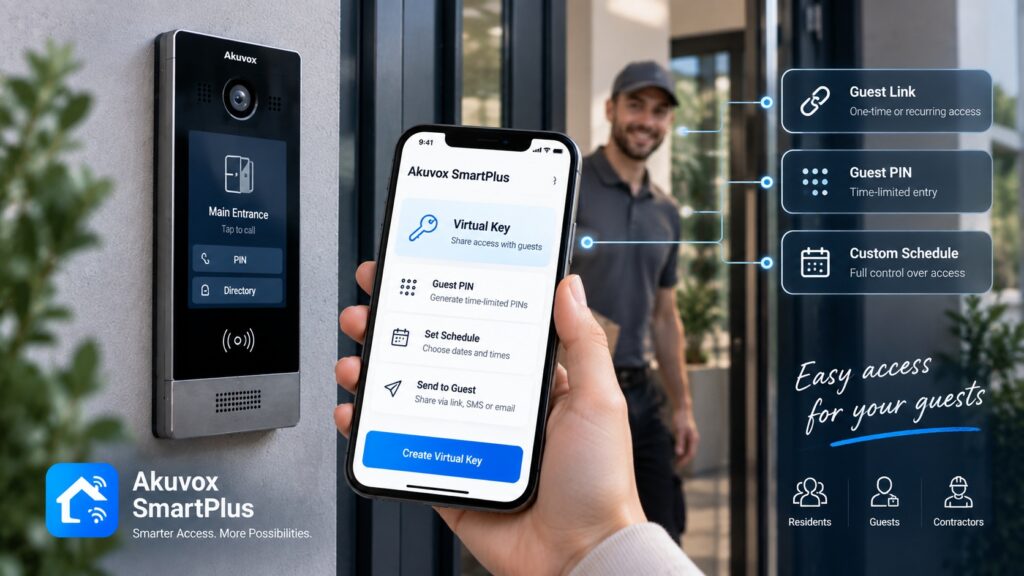
- Temporary credentials.
- Scheduled contractor access.
- Remote authorization.
A typical process is:
Visitor → building entrance → resident verification → access granted
The visitor may only need access to the lobby or another designated area rather than the entire building.
Temporary access can also be useful for contractors who need to visit the property for a specific job. Their permissions can be limited to the relevant entrance and time period.
Apartment Building Intercom and Access Control
An intercom and access-control system have different roles.
Intercom = communication
Access control = authorization
Lock = physical entry
For example, a visitor arrives at the main entrance and uses the intercom to contact a resident. The resident communicates with the visitor and, if appropriate, activates the door-release function.
Residents entering the building themselves can use their own credentials without contacting another person.
This combination allows the same entrance to support both routine resident access and controlled visitor access.
Video intercom can add visual verification, while compatible mobile functions can allow residents to answer calls without being physically next to an indoor monitor.
Access Control for Parking and Garage Entrances
Parking areas often require their own access rules.
A residential building may have:
- Resident parking.
- Assigned parking spaces.
- Visitor parking.
- Garage entrances.
- Vehicle gates.
- Restricted parking areas.
A resident can potentially use a credential that provides access to both the building entrance and an authorized parking entrance.
For example:
Resident credential → building entrance + assigned garage
while a visitor may receive:
Visitor access → designated entrance only
The access-control equipment must be compatible with the garage door or gate operator. The gate operator performs the physical opening function, while the access system determines whether the user is authorized.
Controlling Common Areas
Apartment buildings often contain spaces that are shared by residents but should not necessarily be accessible to everyone at all times.
These can include:
- Gym.
- Pool.
- Lounge.
- Rooftop.
- Package room.
- Laundry room.
- Storage.
- Community room.
Access permissions can be configured separately for these areas.
For example:
Resident → gym → permitted hours
A property manager may choose to provide amenity access only to current residents and restrict it outside established hours.
This creates a more flexible system than using one universal credential that opens every door in the building.
Package Rooms and Delivery Access
Package deliveries are an important consideration for apartment buildings with a high number of residents.
A building may have a dedicated package room or delivery entrance where access needs to be different from resident access.
Possible approaches include:
- Separate delivery entrance.
- Temporary credentials.
- Staff-controlled access.
- Intercom communication.
- Scheduled access.
For example, a delivery person can be directed to a designated entrance instead of receiving unrestricted access to the building.
The exact delivery workflow depends on the property’s management practices and any compatible package-management technology used by the building.
Access Logs and Property Management
Electronic access systems can provide records of access events, depending on the selected platform.
These records may include information such as:
- Credential used.
- Door or entrance accessed.
- Date and time.
- Successful access.
- Denied access.
Access logs can help property management investigate unusual events or determine whether a particular credential was used at a certain entrance.
They can also assist with day-to-day administration when residents report lost credentials or when management needs to review activity around a controlled area.
Access logs should be managed according to applicable privacy, security, and data-retention requirements.
Cloud-Based Access Control for Apartment Buildings
Cloud-managed systems can be useful for property managers who need to administer access remotely.
Potential functions include:
- Adding residents.
- Disabling former tenant credentials.
- Changing access permissions.
- Managing multiple properties.
- Administering users from different locations.
This can be particularly useful for management companies responsible for several apartment buildings.
For example, a manager may be able to update a resident’s access without visiting the building, provided the selected system supports remote administration and the property has the necessary network connectivity.
The suitability of a cloud platform depends on the management company’s IT requirements, internet connectivity, security policies, and the capabilities of the selected access-control platform.
Upgrading Access Control in an Existing Apartment Building
Modernizing an existing building requires an assessment of the current infrastructure.
Important components include:
- Existing locks.
- Readers.
- Intercom.
- Wiring.
- Door hardware.
- Garage gates.
- Network.
- Power.
- Access controllers.
Some existing components may be reusable if they are compatible with the new system.
A phased modernization can also be considered. For example, management may start with the main entrance, then add common areas, parking, and service entrances.
This can be useful when replacing every controlled point at once is not practical.
Before selecting new equipment, the existing infrastructure should be inspected to determine what can remain and what needs to be replaced.
Planning Access Control for a New Apartment Building
New construction provides more flexibility because access control can be incorporated into the building design.
Planning can include:
- Reader locations.
- Door hardware.
- Cable routes.
- Controller locations.
- Network infrastructure.
- Lobby intercom.
- Garage access.
- Common-area entrances.
- Future expansion.
The resident experience should also be considered.
For example, residents may need convenient access to the lobby, garage, package room, and amenities, while contractors and building staff require different permissions.
Planning these access groups before installation can make the final configuration easier to administer.
How to Choose Access Control for an Apartment Building
The system should be selected according to the building’s actual layout and resident management requirements.
- Number of Apartments. The number of residents affects credential management and the scale of the system.
- Number of Entrances. Include main, secondary, service, parking, and other controlled entrances.
- Number of Residents. Estimate the number of users who will need regular access.
- Common Areas. Identify gyms, lounges, package rooms, storage areas, and other spaces that require separate permissions.
- Parking. Determine whether garage doors or vehicle gates need to be controlled.
- Staff Access. Define separate permissions for property managers, maintenance, cleaning, security, and contractors.
- Visitor Management. Consider how guests and service personnel will be admitted.
- Intercom. Determine whether visitors should be able to contact residents before receiving access.
- Access Credentials. Choose between cards, fobs, PINs, mobile credentials, or supported combinations.
- Access Schedules. Determine whether staff or amenity access needs to be restricted by time.
- Cloud Management. Consider whether property managers need remote administration or centralized management across several buildings.
- Existing Infrastructure. Review locks, wiring, readers, intercoms, gates, and network equipment.
- Future Expansion. Consider additional entrances, amenities, parking spaces, or changes to the building’s layout.
A practical selection process is:
Residents → entrances → access groups → common areas → visitors → management → integrations → installation.
Akuvox Access Control for Apartment Buildings in Queens
Akuvox offers access-control and intercom equipment that can be configured for residential properties.
A building configuration can include:
- Smart doorphones.
- Access-control terminals.
- Card and fob access.
- PIN-based entry.
- Mobile access.
- Indoor monitors.
- Door-release functions.
- Intercom integration.
- Supported cloud and mobile management functions.
For example, the main entrance can use an entrance station for visitor communication while residents use authorized credentials for routine entry.
Separate access points can be configured for common areas, service entrances, or other controlled locations according to the building’s requirements.
The appropriate equipment depends on the number of apartments, entrances, residents, common areas, parking facilities, existing door hardware, and desired management functions.
Access Control Installation for Apartment Buildings in Queens
A multi-tenant installation should be planned around the entire building.
- Building Survey. The entrances, common areas, parking, existing locks, intercom, wiring, network, and other infrastructure are reviewed.
- Access Plan. Resident, staff, visitor, contractor, and management permissions are defined.
- Hardware Selection. Readers, controllers, locks, intercom equipment, and other components are selected according to the building’s requirements.
- Installation. The equipment is installed at the main entrance, common areas, parking entrances, service doors, and other controlled locations.
- Tenant Setup. Resident credentials and access groups are configured.
- Staff Configuration. Separate permissions are established for property managers, maintenance personnel, cleaners, security staff, and contractors.
- Testing. Resident, visitor, staff, parking, and common-area access scenarios are tested before the system is placed into regular operation.
This approach helps ensure that the system works not only at the main entrance but throughout the building.
Get an Access Control System for an Apartment Building in Queens
Access control for an apartment building should make everyday entry simple for residents while giving property management control over changing access requirements.
Before planning an installation, it is useful to determine:
- Number of apartments.
- Number of residents.
- Main entrances.
- Secondary entrances.
- Common areas.
- Garage and parking.
- Staff entrances.
- Existing access control.
- Intercom.
- Door hardware.
- Visitor requirements.
- Number of buildings.
Akuvox NYC provides access-control and intercom equipment for apartment properties in Queens. The system can be planned around resident access, common areas, parking, visitor management, staff permissions, and existing infrastructure.
If you are considering apartment building access control in Queens, a property assessment can help determine the appropriate readers, controllers, credentials, locks, intercom equipment, and management approach.
Request a Quote to discuss an access-control solution for your apartment building.
Other Services in QUEENS
Other Locations we Serve
FAQ
Yes. A system can manage the main entrance, secondary doors, common areas, service entrances, parking, and other controlled points.
Yes. Individual cards, fobs, mobile credentials, or other supported credentials can be assigned to residents and managed separately.
Yes. The former resident's credential can be disabled without changing the access credentials of other tenants.
Compatible systems can support mobile credentials. The exact functionality depends on the selected equipment and management platform.
Yes. Multiple doors can be managed through one access-control architecture, with different permissions assigned to each location.
Yes. The intercom can provide visitor communication while the access-control system handles resident credentials and controlled entry.
Yes. Different access groups can be created so that residents receive permissions for the specific areas they are authorized to use.
Yes. Where supported, temporary credentials or scheduled permissions can be assigned for specific doors and time periods.
It can, depending on the selected platform. Systems with centralized management can be useful for property managers responsible for multiple locations.
Yes. Existing locks, readers, wiring, intercoms, network equipment, and other components can be assessed to determine what can be retained.
Compatible systems can record access events that help management review activity, investigate incidents, and administer credentials.
The cost depends on the number of apartments, users, controlled doors, common areas, parking entrances, selected hardware, intercom integration, existing infrastructure, and installation requirements. A property assessment is needed to determine the project-specific cost.
How It Works
Consultation & Needs Assessment
We discuss your property, security goals, and operational requirements to understand your specific needs.
Customized Solution Design
Our specialists recommend and design an intercom or access control solution tailored to your home, apartment building, or commercial facility.
Professional Installation
Certified technicians install and configure all system components, ensuring seamless integration and reliable performance.
Ongoing Support & Maintenance
We provide system testing, user training, maintenance, and technical support to keep your solution operating efficiently for years to come.
Get a Quote
Need an access control or intercom system? Tell us about your project and get a tailored solution from Akuvox NYC.
Other Services
Latest Articles