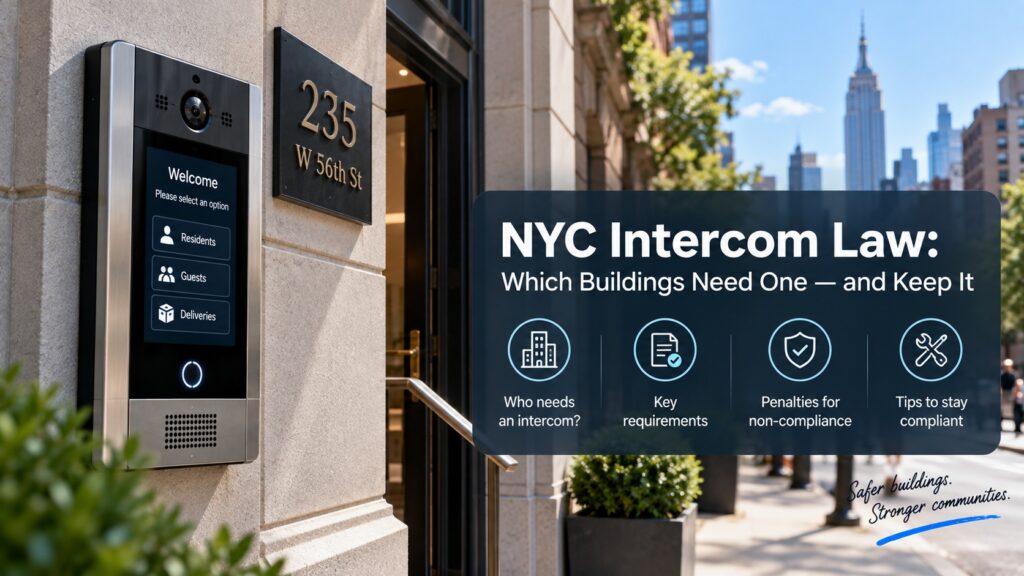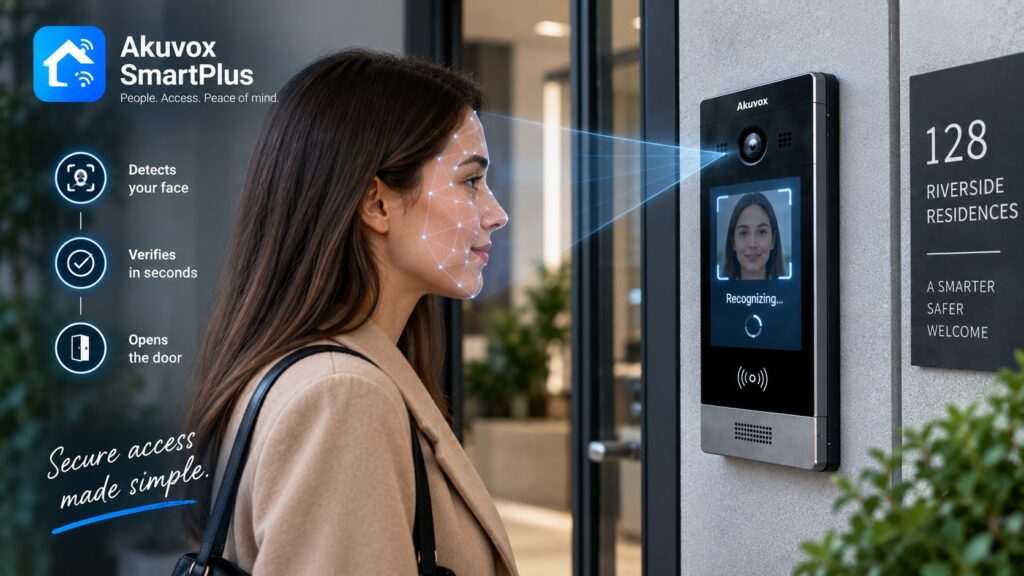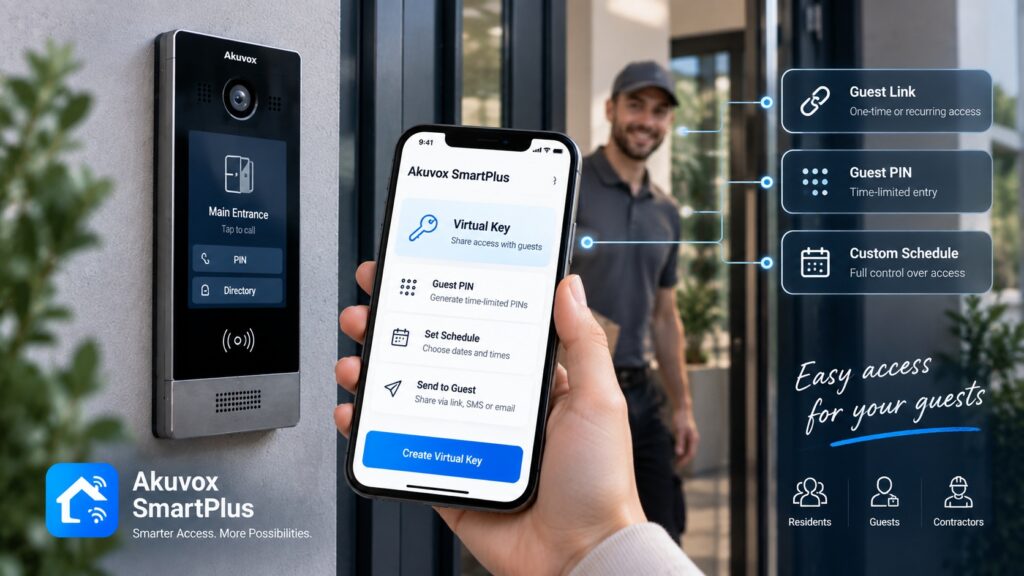

IP intercom system in Queens
An IP intercom uses a property's network infrastructure to connect entrance stations, indoor monitors, access control equipment, and other communication devices. Unlike traditional intercoms that rely on dedicated communication wiring, this technology can provide a more flexible way to connect multiple entry points and users.

Customized Security Solutions
We design tailored intercom and access control systems based on your property's unique requirements, ensuring the right fit for every project.

Professional Installation
Our experienced technicians handle every stage of the installation process, delivering reliable performance and attention to detail.

Advanced Technology
We provide modern, feature-rich solutions with cloud management, mobile access, and seamless integration capabilities.

Ongoing Support & Maintenance
From system setup to long-term service, our team is committed to keeping your security solutions operating efficiently.
Akuvox NYC provides ip intercom systems in Queens for residential and commercial properties. Systems can be designed for apartment buildings, condominiums, offices, private homes, gates, warehouses, and other facilities that need reliable visitor communication and controlled entry.
IP Intercom Solutions for Properties in Queens
An intercom can combine audio communication, video, access management, and network connectivity within one system.
A typical installation may include an entrance station at a door or gate, an indoor monitor, network equipment, access control devices, and compatible door hardware. Depending on the configuration, users can also receive calls through supported mobile applications.
The main advantage of this architecture is flexibility. Additional devices and entry points can often be incorporated without creating an entirely separate communication system for each location.
For new construction, the network infrastructure can be planned together with the intercom. For existing properties, the available network, wiring, power, and door hardware should be assessed before equipment is selected.
How an IP Intercom System Works
An IP intercom uses network connectivity to exchange communication and control signals between connected devices.
The basic process can be represented as:
Entrance device → IP network → receiving device → visitor communication → access authorization → door release.
For example, a visitor arrives at a building entrance and presses the appropriate button on the entrance station. The system sends the call through the network to an indoor monitor, reception station, or compatible mobile device.
The receiving user can communicate with the visitor and, if the system is integrated with compatible access control or door hardware, authorize entry.
The network can connect devices located in different parts of a building or property. This makes IP technology particularly useful when several entrances or communication points need to work together.
What Makes IP Intercom Different from Traditional Systems?
Traditional intercom systems often use dedicated wiring between entrance and indoor devices. Network-based systems use IP communication, which can provide additional flexibility for properties with an established IT infrastructure.
Several differences are particularly important.
- Network-Based Communication — Devices communicate through an IP network rather than relying exclusively on dedicated intercom wiring.
- Scalability — Additional endpoints can be incorporated when the network and system architecture support expansion.
- Multiple Communication Points — Calls can be routed to different monitors, offices, reception stations, or compatible devices.
- Video Transmission — IP networks can support audio and video communication between connected devices.
- Integration — IP intercom equipment can work alongside compatible access control and other network-based technologies.
- Remote Functions — Supported systems can provide mobile communication and other remote capabilities.
These benefits do not mean that IP is automatically the best choice for every property. Existing infrastructure, network design, building size, and project requirements should all be considered.
Main Components of an IP Intercom System
An IP intercom is not a single device. It is a combination of components that perform different functions.
- IP Door Station. Installed at an entrance, the door station allows visitors to initiate calls and, depending on the model, can provide video, audio, access credentials, and other functions.
- Indoor Monitor. An indoor monitor receives calls from the entrance and can allow residents or employees to communicate with visitors and use supported door release functions.
- Network Infrastructure. Ethernet switches, cabling, routers, and other network components provide the communication path between connected devices.
- Access Control Equipment. Access control terminals and readers can manage authorized users separately from visitor communication.
- Door Controller and Lock. Compatible controllers and electronic locking hardware provide the physical mechanism for controlled entry.
- Mobile Device. A compatible smartphone can provide supported communication and access functions when the selected system includes mobile capabilities.
The exact combination depends on the property. A single-family home may need only a few components, while a multi-building property can require a larger distributed system.
Video and Audio Communication over IP
Network-based intercom technology can transmit both audio and video between connected devices.
An ip video intercom system in Queens can provide two-way audio together with a live view of the entrance, allowing the person inside the property to see a visitor before deciding whether to grant access.
This can be particularly useful for:
- Apartment building entrances.
- Office reception areas.
- Private homes.
- Parking entrances.
- Gates.
- Warehouse access points.
- Service entrances.
The quality of the experience depends on the selected devices, network performance, installation, and configuration.
For properties with multiple entrances, IP communication can also make it easier to route calls to the appropriate location instead of installing independent communication systems for every entrance.
IP Intercom and Access Control Integration
An IP intercom and access control system can work together while performing different functions.
IP intercom → visitor communication and identification.
Access control → authentication of authorized users.
Door controller → physical operation of the entrance.
This separation creates different access paths for different groups.
Residents or employees can use assigned credentials for everyday entry. A visitor can contact an authorized person through the intercom before entering. Contractors can receive access according to the property’s procedures.
For example, an apartment building can use access credentials for residents while routing visitor calls to individual apartments. An office can connect the main entrance to reception while employees use separate credentials. A private home can combine a gate intercom with an automated driveway gate.
The exact integration depends on the selected equipment and existing access control infrastructure.
IP Intercom for Different Types of Properties
IP technology can be adapted to a variety of property types.
- Apartment Buildings. IP intercom can connect shared entrances with individual apartments, indoor monitors, access control, and supported mobile functions.
- Condominiums. A connected system can support residents, visitors, property management, and shared entrances.
- Single-Family Homes. Homeowners can use IP doorphones and indoor monitors at front doors, gates, and other controlled entrances.
- Offices. Entrance calls can be directed to reception, individual employees, or other designated communication points.
- Commercial Buildings. Multiple tenants, entrances, parking areas, and service locations can be incorporated into a coordinated system.
- Warehouses. IP communication can connect loading areas and service entrances with employees or security personnel.
- Gates and Parking Entrances. Outdoor entrance stations can communicate with users inside the property and, where compatible, connect to gate control equipment.
The architecture can therefore be adjusted according to the number of users, entrances, and access requirements.
IP Intercom for Multiple Entrances and Large Properties
Larger properties often have several communication points. A building may have a main lobby, secondary entrance, parking access, loading area, and employee-only doors.
With an IP-based architecture, these locations can be connected through the property’s network rather than operating as completely separate communication systems.
This can provide a more organized approach to:
- Multiple buildings.
- Multiple entrances.
- Parking areas.
- Service entrances.
- Reception points.
- Security stations.
- Different user groups.
The system can be designed so that each entrance has the appropriate equipment and communication destination. Not every access point needs to have identical functionality.
For example, the main entrance may require video communication, while a restricted service door may only need a basic communication point.
Mobile Access and Remote IP Intercom Functions
One of the useful features of a network-based intercom is the ability to support compatible mobile services.
Depending on the Akuvox equipment and configuration, users may be able to receive intercom calls through a smartphone, communicate with visitors, and use supported access functions remotely.
This can be useful for:
- Residents who are away from home.
- Property managers.
- Business owners.
- Office employees.
- Reception personnel.
- Homeowners expecting deliveries.
Mobile functionality should be considered as part of the complete system design. The available features depend on the equipment, software, network connectivity, and services being used.
IP Intercom and Existing Network Infrastructure
An IP intercom depends on the property’s network environment, so infrastructure should be reviewed before installation.
- Network Availability. The property needs suitable connectivity between the locations where IP devices will be installed.
- Bandwidth. Video communication can require more network capacity than basic audio communication, particularly when multiple devices are active.
- Power. Some IP equipment can use Power over Ethernet, while other installations may require separate power arrangements.
- Network Security. Intercom devices should be incorporated into the network according to the property’s security and administration requirements.
- Internet Dependency. Local IP communication and cloud or mobile functions can have different connectivity requirements. The system should be designed accordingly.
- Existing Equipment. Existing switches, cabling, door hardware, access control, and other infrastructure should be evaluated for compatibility.
A network assessment helps determine whether the existing infrastructure can support the planned system or whether upgrades are necessary.
IP Intercom vs. 2-Wire Intercom
IP and 2-wire technologies can both be useful, but they address different installation conditions.
An IP solution can be particularly attractive when a property has suitable Ethernet infrastructure and needs flexible communication between multiple network-connected devices.
A 2-wire solution can be worth considering when an existing building has legacy intercom wiring and replacing all cabling would be difficult or unnecessarily disruptive.
The decision should therefore be based on the actual property rather than simply comparing the price of individual devices.
Factors such as building age, existing wiring, number of apartments, network availability, desired video functions, and future expansion should be considered before choosing the technology.
Upgrading an Existing Intercom to IP
An older analog intercom does not necessarily have to remain limited to basic audio communication.
Depending on the property, modernization may include:
- Replacing the entrance panel.
- Installing IP indoor monitors.
- Adding video communication.
- Upgrading network infrastructure.
- Integrating access control.
- Introducing mobile communication.
- Adding additional entrances.
- Connecting compatible door release equipment.
The first step should be an assessment of the existing system. Wiring, power, entrance equipment, indoor devices, door hardware, and network infrastructure can all affect the modernization strategy.
Some properties may benefit from a gradual upgrade, while others may be better suited to a complete replacement.
IP Intercom Installation in Queens
Akuvox NYC provides professional installation for residential and commercial properties in Queens.
The process can include:
- Reviewing the property’s existing infrastructure.
- Evaluating network connectivity.
- Identifying entrances and communication points.
- Determining user and access requirements.
- Selecting compatible Akuvox equipment.
- Designing the intercom architecture.
- Installing door stations and indoor devices.
- Configuring network connections.
- Integrating access control and door release equipment.
- Setting up supported mobile functions.
- Testing audio, video, communication, and access.
- Providing user and administrator guidance.
- Supporting the system after installation.
For larger properties, installation can be planned in stages to reduce disruption to residents, employees, tenants, and normal business operations.
How to Choose an IP Intercom System
The right equipment depends on the property’s size, infrastructure, and intended use.
- Number of Users. The number of residents, employees, tenants, or other users determines how many communication and access endpoints may be required.
- Number of Entrances. Each entrance should be evaluated according to its function, location, visitor traffic, and access requirements.
- Video Requirements. Properties that need visual visitor verification should use compatible video door stations and receiving devices.
- Existing Network. The available Ethernet infrastructure, switches, cabling, and network configuration can influence the appropriate system architecture.
- PoE Availability. Power over Ethernet can simplify installation for compatible devices when the network infrastructure supports it.
- Access Control Integration. If the property already has electronic access control, compatibility should be checked before selecting intercom equipment.
- Mobile Functions. If users need to receive calls or manage supported entry functions from smartphones, the system should be selected accordingly.
- Future Expansion. The installation should allow for potential additional entrances, users, devices, or access functions when the property is expected to grow or change.
- Outdoor Installation Requirements. Equipment installed at gates and exterior entrances should be appropriate for the property’s environmental conditions.
Why Choose Akuvox for IP Intercom?
Akuvox develops IP-based communication and access technologies that can be combined for different residential and commercial applications.
Depending on the project, an Akuvox installation can include:
- IP video doorphones.
- Indoor monitors.
- SIP communication.
- Access control terminals.
- Door controllers.
- Mobile communication.
- Smart entry devices.
- Solutions for existing building modernization.
The equipment can be combined according to the requirements of the property rather than using the same configuration for every installation.
Akuvox NYC can assist with system planning, equipment selection, network considerations, installation, configuration, access control integration, and ongoing technical support in Queens.
Install an IP Intercom System in Queens
An IP intercom can provide a flexible foundation for visitor communication and controlled entry across residential and commercial properties. Its network-based architecture can support video, multiple communication points, access control integration, and compatible mobile functions.
Akuvox NYC can assess your existing network and entrance infrastructure, determine the appropriate system architecture, select compatible equipment, and handle professional installation and configuration in Queens.
Contact Akuvox NYC to discuss your property and develop an IP intercom solution that fits its entrances, users, network infrastructure, and access requirements.
Other Services in QUEENS
Other Locations we Serve
FAQ
An IP intercom is a communication and entry system that uses an IP network to connect entrance stations, indoor devices, access control equipment, and other compatible endpoints.
A visitor initiates a call at an entrance station. The call travels through the network to a compatible receiving device, allowing the user to communicate with the visitor and, when integrated with compatible equipment, authorize entry.
Not necessarily for every local function. Devices can communicate over a local network, while certain cloud or mobile features may require internet connectivity.
Compatible IP devices can use Power over Ethernet when the network infrastructure and equipment support PoE.
Yes. An IP intercom can be integrated with compatible access control equipment, door controllers, electric locks, or release mechanisms.
Yes. The two systems can work together so that intercom handles visitor communication while access control manages authorized users and credentials.
Compatible Akuvox systems can support mobile communication and certain remote access functions. The exact features depend on the equipment and configuration.
IP technology can provide greater flexibility, especially for properties with suitable network infrastructure and multiple connected devices. However, the best option depends on the property's existing wiring and requirements.
In many cases, an existing system can be replaced or modernized with IP equipment. The available approach depends on the existing wiring, network, door hardware, and desired functions.
The cost depends on the number of entrances and users, equipment selection, network infrastructure, wiring, access control integration, and installation complexity. A site assessment is needed for an accurate estimate.
How It Works
Consultation & Needs Assessment
We discuss your property, security goals, and operational requirements to understand your specific needs.
Customized Solution Design
Our specialists recommend and design an intercom or access control solution tailored to your home, apartment building, or commercial facility.
Professional Installation
Certified technicians install and configure all system components, ensuring seamless integration and reliable performance.
Ongoing Support & Maintenance
We provide system testing, user training, maintenance, and technical support to keep your solution operating efficiently for years to come.
Get a Quote
Need an access control or intercom system? Tell us about your project and get a tailored solution from Akuvox NYC.
Other Services

Latest Articles