
Residential access control system in Brooklyn
A residential property needs access control that protects the entrance without making everyday life unnecessarily complicated. Residents should be able to enter easily, family members may need individual credentials, and guests or service providers may require access only for a limited period. A properly planned residential access control system can bring these requirements together for private homes, townhouses, condominiums, multi-family properties, and residential communities.

Customized Security Solutions
We design tailored intercom and access control systems based on your property's unique requirements, ensuring the right fit for every project.

Professional Installation
Our experienced technicians handle every stage of the installation process, delivering reliable performance and attention to detail.

Advanced Technology
We provide modern, feature-rich solutions with cloud management, mobile access, and seamless integration capabilities.

Ongoing Support & Maintenance
From system setup to long-term service, our team is committed to keeping your security solutions operating efficiently.
Akuvox offers access control terminals, intercom equipment, mobile access options, facial recognition devices, door controllers, and elevator access solutions that can be combined according to the characteristics of a residential property.
What Residential Access Control Can Control
Access control does not have to be limited to the front door. A residential property may have several points where it is useful to determine who is allowed to enter.
Depending on the property, controlled access can include:
- Main building entrance.
- Front and rear doors.
- Side entrances.
- Pedestrian gates.
- Driveway gates.
- Garage doors.
- Parking entrances.
- Storage rooms.
- Laundry rooms.
- Fitness or community areas.
- Rooftop spaces.
- Service and maintenance areas.
For a single-family home, the configuration may be relatively compact. A larger residential community can require several entrances, common areas, parking access, and different permissions for residents, staff, and visitors.
The first step is therefore to identify all access points that need control rather than choosing equipment for one door in isolation.
Everyday Access for Residents
For residents, the most important part of an entry system is often convenience. A solution that is technically secure but difficult to use can quickly become frustrating when it is used several times every day.
Depending on the selected Akuvox equipment, residents can have different ways to enter:
- Access cards.
- PIN codes.
- NFC.
- Bluetooth.
- Smartphone-based access.
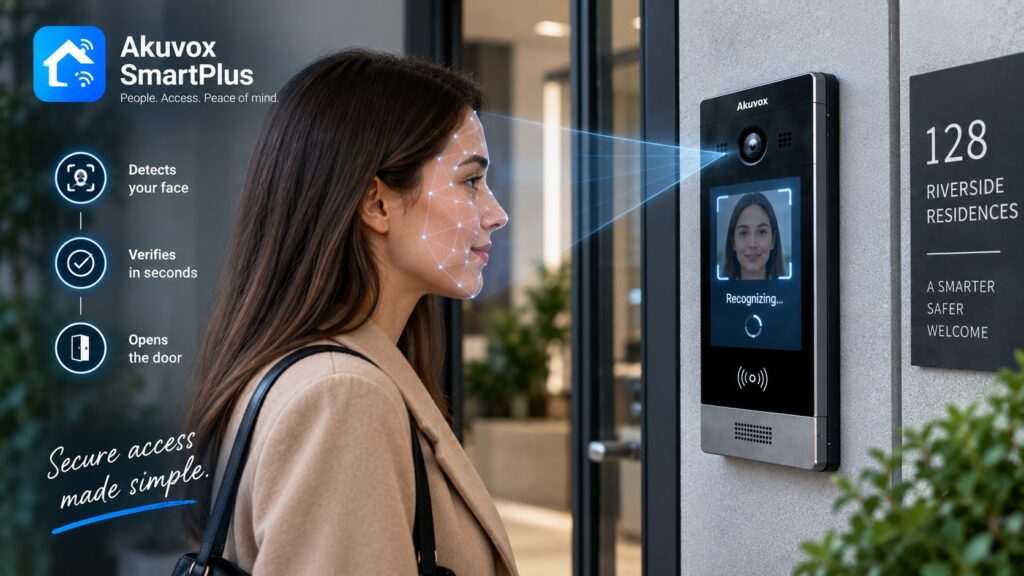
- Facial recognition on compatible terminals.
A resident may use a physical card as the primary credential while another user prefers a smartphone. The available combination depends on the installed devices and system configuration.
For properties that need residential door access control in Brooklyn, individual credentials can also make access management more practical. If one card is lost or a user’s access needs to be changed, the affected credential can be managed without necessarily changing access for everyone else.
Managing Access for Family Members
A private residence can have several people who need regular access but may not use the property in exactly the same way.
Parents, children, elderly family members, household employees, caregivers, and other authorized users can require different credentials or permissions depending on the situation.
Individual access credentials can help a homeowner distinguish between users rather than relying on one shared key or PIN.
For example:
- Adults can receive regular access.
- Children can use an appropriate credential for the entrance.
- A caregiver can receive access during an agreed period.
- Household staff can receive access only when required.
- A former resident can have their permissions removed.
This approach provides more control than distributing one universal key or access code to everyone who may need to enter the property.
Guest and Visitor Access
Visitors are different from residents because they usually do not need permanent access.
Friends and relatives may visit occasionally, while contractors, cleaners, delivery personnel, and service technicians may need access for a specific purpose.
A controlled visitor process can look like this:
Visitor arrives → resident verifies the visitor → access is granted → visitor enters through the authorized entrance.
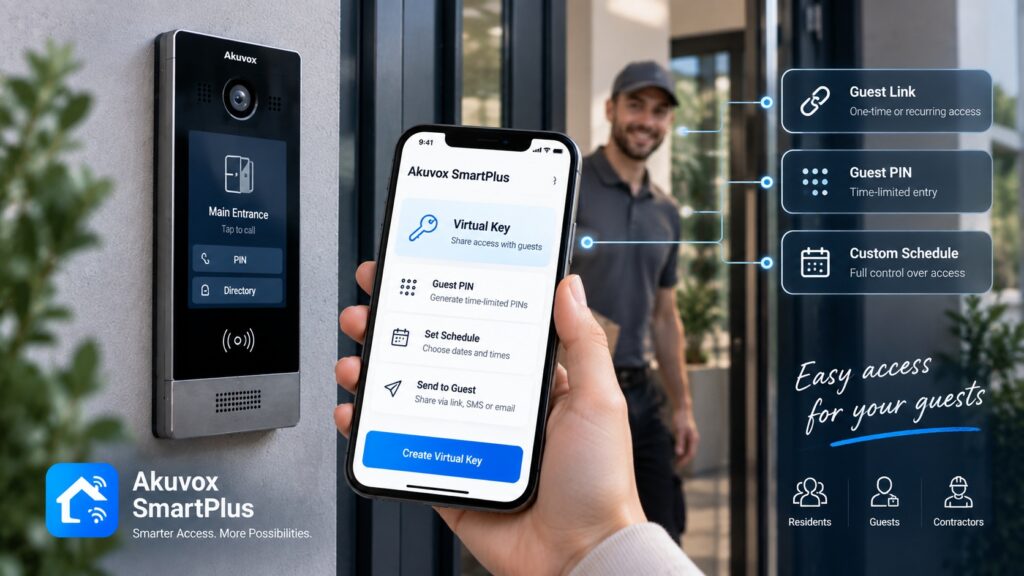
For compatible Akuvox and SmartPlus configurations, temporary credentials such as PINs or QR codes can be used for certain visitor scenarios. Validity periods and access restrictions can be configured where supported.
This can be useful when a homeowner or property manager wants to provide access without handing over a permanent credential that remains valid after the visit.
Access Control for Garages, Gates and Driveways
Residential properties often have more than one way to enter. A garage, driveway gate, pedestrian gate, or parking entrance may require the same level of access management as the building itself.
For properties with several external entry points, residential gate access control systems in Brooklyn can be incorporated into a broader access strategy when the gate hardware, controller, and selected access equipment are compatible.
The appropriate configuration depends on the type of gate or door hardware and the access methods required.
For example, a property may need to distinguish between:
- Residents who can use the main entrance and garage.
- Guests who can access only the main entrance.
- Service personnel who need the service entrance.
- Contractors who require temporary access to a particular area.
Managing these points as part of a coordinated access strategy can be more practical than maintaining completely separate credentials and systems for every entrance.
Residential Access for Multi-Family Properties
A multi-family property introduces another level of complexity because many independent households share the same infrastructure.
Residents need regular access to common entrances, while property managers and maintenance personnel may require additional permissions. Visitors may need temporary entry, and some areas may be restricted to specific users.
A suitable configuration can provide separate access rights for:
- Individual residents.
- Property management.
- Maintenance staff.
- Cleaning personnel.
- Contractors.
- Visitors.
The system can also be extended to additional entrances, common areas, parking, and elevators when the selected equipment supports these functions.
This makes access management more structured than using one shared credential for an entire residential property.
Protecting Shared Residential Areas
Not every part of a residential property needs to be accessible to every resident.
For example, a condominium or residential community may have:
- Laundry facilities.
- Storage areas.
- Fitness rooms.
- Community rooms.
- Rooftops.
- Parking areas.
- Package or delivery areas.
- Mechanical rooms.
Access permissions can be organized around these areas. Residents may receive access to common facilities, while service rooms remain restricted to authorized personnel.
This is particularly useful when the property contains amenities that are shared by many residents but should not be treated as unrestricted public spaces.
Choosing the Right Entry Method for a Residence
The best access method depends on who uses the property and how the entrance operates.
Access Cards
Cards are straightforward for residents and can be individually assigned. They can be a practical choice for condominiums, apartment properties, and other locations with many regular users.
PIN Codes
A PIN provides entry without a physical card. It can be useful for selected users or situations where carrying a credential is inconvenient.
Smartphone Access
Mobile access allows compatible users to use their smartphone as part of the entry process. This can be convenient for residents who already carry their phone whenever they leave home.
Bluetooth
Bluetooth can provide contactless access through compatible devices and configurations. It can be useful for everyday entry when residents want to avoid using a physical card.
Facial Recognition
Facial recognition can provide hands-free authentication through compatible Akuvox terminals. It may be suitable for properties where contactless entry is a priority.
Not every device supports every access method. Hardware should therefore be selected according to the required user experience rather than assuming that all available technologies can be combined in one installation.
Residential Access Control for New and Existing Properties
The installation process can be different depending on whether the property is being built or already occupied.
New Construction
A new residential property provides an opportunity to plan access control together with doors, locks, network infrastructure, intercoms, elevators, and other building systems.
Planning these elements together can help avoid unnecessary modifications later and make it easier to determine where controllers, terminals, and other equipment should be installed.
Existing Residence
An existing property may already have an intercom, keypad, card reader, electronic lock, or other access equipment.
Before replacing or adding equipment, it is important to review the existing doors, locks, wiring, network, and access hardware. In some cases, parts of the existing infrastructure may be compatible with a new solution; in others, additional modifications may be required.
The goal should be to determine the most practical upgrade path rather than replacing every component automatically.
Access Control and Residential Intercom
An intercom can add another layer to the entry process by allowing residents to communicate with visitors before opening the door.
A typical scenario is:
Visitor arrives → visitor calls the residence → resident receives the call → visitor is identified → resident releases the door.
Akuvox offers smart doorphones and indoor monitors that can be combined with compatible access control equipment.
For a residential property, this can be useful because residents do not have to physically approach the entrance every time someone arrives. Depending on the configuration, compatible mobile functions can also allow communication and remote door opening through a smartphone.
For multi-unit properties, the intercom can additionally help direct a visitor to the appropriate apartment or resident before access is granted.
Residential Access Control for Different Types of Homes
Different residential properties have different access requirements, so there is no single configuration that works for all of them.
Single-Family Homes
A private house may require access control for the front door, garage, driveway gate, or side entrance. The focus is usually on family members, household staff, and visitors.
Townhouses
Townhouses may combine a private entrance with parking or shared community access. The system can be planned around the doors and gates that require controlled entry.
Condominiums
Condominium properties typically have shared entrances, common areas, parking, and multiple residents. Access permissions can be organized according to residents, staff, visitors, and restricted areas.
Multi-Family Buildings
These properties require access management for many independent households, along with property management, maintenance, visitor, and service access.
Residential Communities
Larger communities can have several buildings, pedestrian gates, vehicle entrances, parking areas, and shared amenities. A broader access architecture may be required to coordinate these points.
What to Consider Before Installing Residential Access Control
Before choosing equipment, it is useful to map the property’s actual access requirements.
Consider:
- Number of entrances: Identify doors, gates, garages, and other controlled points.
- Number of residents: Estimate how many regular users will need credentials.
- Additional users: Include staff, contractors, caregivers, and service personnel.
- Visitor access: Determine whether temporary credentials are required.
- Common areas: Decide which facilities should be accessible to residents and which should remain restricted.
- Intercom: Establish whether residents need to communicate with visitors before granting access.
- Elevator: For multi-story properties, determine whether access to particular floors needs to be controlled.
- Preferred credentials: Decide whether cards, PINs, mobile access, Bluetooth, NFC, or facial recognition are appropriate.
- Existing equipment: Review current locks, intercoms, wiring, controllers, and network infrastructure.
- Future changes: Consider whether additional entrances, residents, or common areas may be added later.
This assessment provides a better basis for selecting equipment than choosing a terminal first and trying to adapt the rest of the property around it.
Why Choose Akuvox for Residential Access Control?
Akuvox offers several technologies that can be combined for residential entry and visitor management.
Depending on the project, a configuration can include:
- IP access control terminals.
- Facial recognition terminals.
- Card-based entry.
- Bluetooth and mobile access.
- Smart doorphones.
- Indoor monitors.
- Multi-door controllers.
- Elevator access control.
- SmartPlus mobile and cloud functions.
This range makes it possible to build a relatively simple solution for a private residence or a more comprehensive configuration for a condominium, multi-family building, or residential community.
The important consideration is selecting compatible equipment according to the number of users, controlled points, required credentials, and existing infrastructure.
Get a Residential Access Control System in Brooklyn
Residential access control should make a property easier to manage while giving authorized users convenient ways to enter. The appropriate solution depends on the type of residence, number of entrances, number of users, visitor requirements, and whether additional areas such as garages, gates, elevators, or common rooms need to be controlled.
Akuvox NYC provides Akuvox access control and residential intercom products for properties in Brooklyn. Share the details of your property and the access points you want to control to determine which equipment and configuration may be appropriate.
Request a Quote to discuss a residential access control solution for your property in Brooklyn.
Other Services in BROOKLYN
Other Locations we Serve
FAQ
Yes. Compatible Akuvox devices and SmartPlus configurations can support mobile access and Bluetooth-based entry. The available functionality depends on the selected equipment and system configuration.
Yes. Individual credentials can be assigned to different authorized users. This makes it possible to manage access separately rather than relying on one shared key or code.
Compatible configurations can support temporary credentials such as PINs or QR codes with defined validity periods. The available options depend on the equipment and SmartPlus setup.
It can be incorporated into a broader access strategy when the gate, door hardware, controller, and selected access equipment are compatible. The required configuration depends on how the gate or garage is operated.
Yes. Access rights can be organized according to users and controlled areas where the selected system supports these permissions. This can allow certain facilities to remain available only to authorized residents or staff.
Yes, although the installation requirements depend on the existing door, lock, wiring, network, and other equipment. These components should be evaluated before selecting the new access control hardware.
Yes. Akuvox offers access control and video intercom products that can be used together in compatible configurations. Residents can communicate with visitors before granting access.
Yes. The configuration can be adapted to the property's layout. A townhouse may require control of a private entrance and gate, while a condominium may need shared entrances, common-area access, parking, and elevator control.
Yes. Akuvox offers access control equipment for doors as well as the EC33 IP Elevator Access Controller. The exact configuration depends on the building, number of users, entrances, and required floor permissions.
There is no universal answer. Cards may be practical for multi-family properties, while smartphone or Bluetooth access may be more convenient for private residences. Facial recognition, PINs, and other methods can also be considered depending on the requirements of the property.
How It Works
Consultation & Needs Assessment
We discuss your property, security goals, and operational requirements to understand your specific needs.
Customized Solution Design
Our specialists recommend and design an intercom or access control solution tailored to your home, apartment building, or commercial facility.
Professional Installation
Certified technicians install and configure all system components, ensuring seamless integration and reliable performance.
Ongoing Support & Maintenance
We provide system testing, user training, maintenance, and technical support to keep your solution operating efficiently for years to come.
Get a Quote
Need an access control or intercom system? Tell us about your project and get a tailored solution from Akuvox NYC.
Other Services
Latest Articles