
NYC Intercom Law: Which Buildings Need One — and Keep It

A quick note before we start: this is background from an installer’s point of view, not legal advice. Your exact obligations turn on your specific building and can shift as rules are updated, so run anything binding past a lawyer or the appropriate New York City agency.
We field the same call constantly from owners and managing agents across the five boroughs: does the NYC intercom law actually force us to keep a working buzzer, or is it optional? It is rarely optional. NYC treats the entrance intercom as part of how a building keeps residents safe, so the law reaches a large slice of the city’s apartment stock — and it does not switch off once the hardware is on the wall.
Here is the short version. If your building became apartments after January 1, 1968, is classified Class A, and holds at least 8 units, the intercom law applies. You then owe residents a buzzer at a self-locking entrance that lets them talk to a visitor and open the door from their own unit.
Does the NYC intercom law apply to your building?
Set the legalese aside for a second. Whether Section 50-a of the Multiple Dwelling Law puts you on the hook comes down to three things about your building, and all three have to be true at the same time.
| What we check | It triggers the rule when… |
|---|---|
| How it is classified | It is a Class A multiple dwelling — lived in as a permanent home, which fits almost every apartment building. |
| When it became apartments | It was built, or converted to residential use, after January 1, 1968. |
| How many units it has | It contains eight or more apartments (8+). |
Miss any one of the three and Section 50-a does not force your hand. Hit all three and an intercom stops being a nice-to-have and becomes a requirement.
Older buildings and conversions
The 1968 line is where most of the confusion lives, because so much of Brooklyn and upper Manhattan went up long before it.
- Pre-1968 walk-ups: An old brownstone or tenement from the 1920s is not automatically covered, but an owner generally has to add a system once a majority of residents ask for one.
- Loft and warehouse conversions: The clock starts at conversion, not original construction, so a 1900s warehouse turned into apartments in 1978 counts as post-1968.
- Smaller buildings: A six-unit building falls under the eight-apartment threshold, though plenty of owners still fit a buzzer because tenants expect one.
What “having an intercom” actually means
The law cares about what the system does, not its brand or vintage. Boiled down, a compliant entrance has to handle three jobs.
- Lock itself: The intercom sits at a door that latches on its own and controls who reaches the lobby.
- Carry a conversation: A resident upstairs can hear and speak with whoever is standing at that door.
- Release from the unit: That same resident can pop the lock from inside the apartment, without coming down to the lobby.
That is the floor: voice plus a remote release. Everything modern sits on top of it, which is why a system from the 1980s and a brand-new video panel can both be compliant as long as those two jobs work.
Which type of system clears the requirement
Because the law fixes a function rather than a product, several kinds of system qualify. The real question is how much you want above the bare minimum.
| System type | Meets the Section 50-a floor | What it adds | Best for |
|---|---|---|---|
| Modern audio panel | Yes — voice and release | Reliability at the lowest cost | Small, budget-led buildings |
| 2-wire video | Yes | A camera over the existing wiring | Older buildings keeping their cabling |
| IP or cloud video | Yes | Video, mobile release, remote management | Buildings that want app access and easy admin |
An Akuvox video door phone such as the R29 covers most mid-size buildings that want solid video and app release through SmartPlus. For a long tenant list, the 10-inch S539 handles a full directory, and where a building wants face recognition at the door, the X915 adds it. All three do the required voice-and-release jobs first, then layer features on top.
Related entrance rules worth knowing
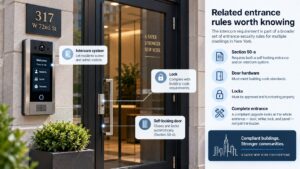
The intercom requirement does not stand on its own. Section 50-a ties the buzzer to a self-locking entrance, so the two are really one obligation: a door that secures itself, plus a way for residents to screen and admit visitors from upstairs.
New York’s housing code carries other entrance-security expectations for multiple dwellings as well, from door hardware to locks. None of that replaces the intercom rule, but it is why a sensible upgrade looks at the whole entrance — door, strike, lock, and panel — instead of the buzzer in isolation.
Co-op, condo, or rental: who has to act
The obligation lands differently depending on how your building is held, even though the underlying requirement is the same.
- Rental buildings: The owner or landlord is responsible for installing and maintaining the entrance system.
- Co-ops: The cooperative corporation, through its board and managing agent, handles the lobby intercom as a building-wide system.
- Condos: The condominium board is generally responsible for the entrance as a common element, with the cost shared among unit owners.
So if you are a shareholder or unit owner staring at a dead lobby panel, the fix usually runs through the board rather than your own apartment.
When a dead buzzer becomes a violation
Putting the system in is only the first half. The second half, the part owners tend to forget until a tenant complains, is keeping it alive. New York’s Housing Maintenance Code expects the entry system in a multiple dwelling to stay in working order, and a buzzer that has quietly failed is treated as a real defect.
- It reads as an essential service: Inspectors see a door that will not release as a security and delivery problem, not a cosmetic one.
- One 311 call starts the clock: A resident can report the outage, which can bring an HPD inspection and a violation if the fault is left to linger.
- It feeds habitability disputes: A long-dead entry system can become ammunition in a warranty-of-habitability claim, so a quick repair is the cheaper road.
What enforcement actually looks like
In practice, enforcement is complaint-driven rather than proactive. Here is the sequence we see when a building lets an outage drift.
- A resident files with 311: The complaint is routed to HPD as a housing maintenance issue.
- HPD inspects: An inspector confirms the fault and can issue a violation that has to be corrected by a set date.
- The clock runs to a re-inspection: Fix and certify the system in time and the matter closes; miss the window and penalties or further action can follow.
The takeaway is simple: the cost of a prompt repair is tiny next to the cost and hassle of a logged violation and a re-inspection.
How buildings quietly fall out of compliance
Most non-compliance we run into is not a building that never had an intercom — it is a system that has decayed in place. The failures are easy to miss from the lobby.
- Dead stations in some units: The panel works, but a handful of apartments lost their station years ago, so those residents cannot buzz anyone in.
- A disabled release: A worn strike or a cut release wire means the talk path works but the door never actually unlocks from upstairs.
- A propped or defeated door: When the buzzer is unreliable, residents prop the entrance, which quietly undoes the self-locking setup the law is built around.
Any of these can turn a technically present system into a non-working one in an inspector’s eyes, which is why we check every unit, not just the lobby panel, during a survey.
Getting compliant without the drama
For most buildings the path is short.
- Pin down your status: Line up your build-or-conversion year, occupancy class, and unit count against the three facts above.
- Pick a system that clears the floor: Anything that gives voice plus in-unit release qualifies, and a modern apartment intercom system on IP or 2-wire does that while adding visitor video.
- Line up service from day one: Choose hardware and an installer who can keep it running, so the next fault is a service call rather than a summons.
Before you call anyone, you can sanity-check your own position.
- Confirm the three facts: Class A, post-1968, and eight or more units should all be true.
- Test the full path: Every apartment should have voice contact and a working release, not just the lobby panel.
- Check the door: The entrance should self-lock rather than sit propped because the system is unreliable.
- Know your service plan: You should know who fixes the system, and how fast, when it next fails.
We design and install entrance systems that clear the requirement across Brooklyn, the rest of the five boroughs, and Long Island. If you are not sure whether your building qualifies, or whether the system you already have still counts, send us the details and we will tell you straight.
Frequently asked questions
Does my NYC building need an intercom?
If it is Class A, became apartments after January 1, 1968, and has eight units or more, then yes — the three together make it mandatory.
What is Multiple Dwelling Law Section 50-a?
It is the state rule behind the requirement: a qualifying building must put a buzzer at a self-locking entrance and let residents both speak to visitors and open the door from their apartments.
Do I need a video intercom to comply?
No. The law only requires voice and a door release from the apartment, so a modern audio system is compliant; video is an upgrade many buildings choose, not a legal must.
Does every apartment need its own station?
Residents must be able to speak with visitors and release the door from their unit, so each occupied apartment needs working access to the system, whether that is a wall station or an app.
Do pre-1968 buildings need an intercom?
Not automatically. An owner usually has to add one only after a majority of residents request it, though many install a system anyway for everyday security.
How fast do I have to fix a broken intercom?
There is no single universal number, but because it is treated as an essential service, an unrepaired fault can draw a violation with a correction deadline, so prompt repair is the safe course.
Does a tablet or app count as a compliant in-unit station?
A setup that reliably gives a resident voice contact and door release from inside the apartment can serve the requirement; confirm the specifics for your building before relying on it.
To dig deeper, the primary references are Section 50-a of New York’s Multiple Dwelling Law, the New York City Housing Maintenance Code, and the maintenance guidance HPD publishes on NYC.gov.
Related Articles