
Intercom system for apartment buildings in Brooklyn
An apartment building intercom has to do more than connect a visitor with someone inside the property. It needs to route calls to the correct apartment, give residents a convenient way to identify visitors, and provide a reliable method for releasing the entrance. For property managers, the system should also be manageable as residents move in and out and as the building's requirements change.

Customized Security Solutions
We design tailored intercom and access control systems based on your property's unique requirements, ensuring the right fit for every project.

Professional Installation
Our experienced technicians handle every stage of the installation process, delivering reliable performance and attention to detail.

Advanced Technology
We provide modern, feature-rich solutions with cloud management, mobile access, and seamless integration capabilities.

Ongoing Support & Maintenance
From system setup to long-term service, our team is committed to keeping your security solutions operating efficiently.
A properly planned apartment building intercom entry systems in Brooklyn configuration can connect the main entrance with individual units, indoor monitors, smartphones, access control equipment, and other building systems. The configuration depends on the number of apartments, entrances, residents, and required functions.
How Apartment Intercom Systems Are Organized
A typical multi-unit installation can be organized around the following workflow:
Building entrance → Main doorphone → Apartment / Resident → Indoor monitor or smartphone → Door release
The entrance station is where a visitor initiates a call. The system then routes the call to the appropriate apartment or resident.
The resident can communicate with the visitor and, where the equipment supports it, see them on video. After deciding whether to allow entry, the resident can release the controlled entrance.
A larger property may additionally include:
- Multiple entrance stations.
- Indoor monitors in apartments.
- Smartphone communication.
- Access control terminals.
- Elevator control.
- Parking entrances.
- Property management functions.
The system should be designed around the building’s actual layout rather than treating the entrance panel as an isolated device.
One Entrance, Multiple Apartments
The main challenge in a multi-unit property is routing each visitor to the correct resident.
A shared entrance station may serve dozens or hundreds of apartments. The visitor needs a practical way to identify the desired unit, while the system needs to send the call to the corresponding resident.
A simple example is:
Visitor selects Unit 5B → resident receives the call → resident communicates with the visitor → resident releases the lobby entrance.
The same principle can be used for different apartment numbering structures or resident directories, depending on the equipment.
Before selecting an entrance station, consider the number of units, how residents will be listed, whether a directory is required, and whether the building has one or several entrances.
For a large property, these details can have a significant impact on the choice of intercom hardware.
A multi-tenant intercom system in Brooklyn can be particularly useful when one entrance station needs to serve many independent residents while keeping their calls and access permissions separate.
What Residents Can Do from Their Apartment
From the resident’s perspective, an intercom should make visitor management simple.
Depending on the selected equipment, a resident may be able to:
- Receive an incoming call.
- See the visitor.
- Talk to the visitor.
- Release the building entrance.
- Monitor a connected entrance.
- Receive calls on a smartphone.
- Use additional supported access functions.
An indoor monitor can provide a dedicated device inside the apartment. Mobile functionality can provide another option for residents who are away from home.
For properties that require visual verification, video intercom systems for apartment buildings in Brooklyn can allow residents to communicate with visitors while viewing the entrance through compatible devices.
The available functions depend on the intercom model and system configuration, so they should be established before equipment is selected.
Visitor Management in Apartment Buildings
Visitors are not all the same, and residents may need to handle different types of requests throughout the day.
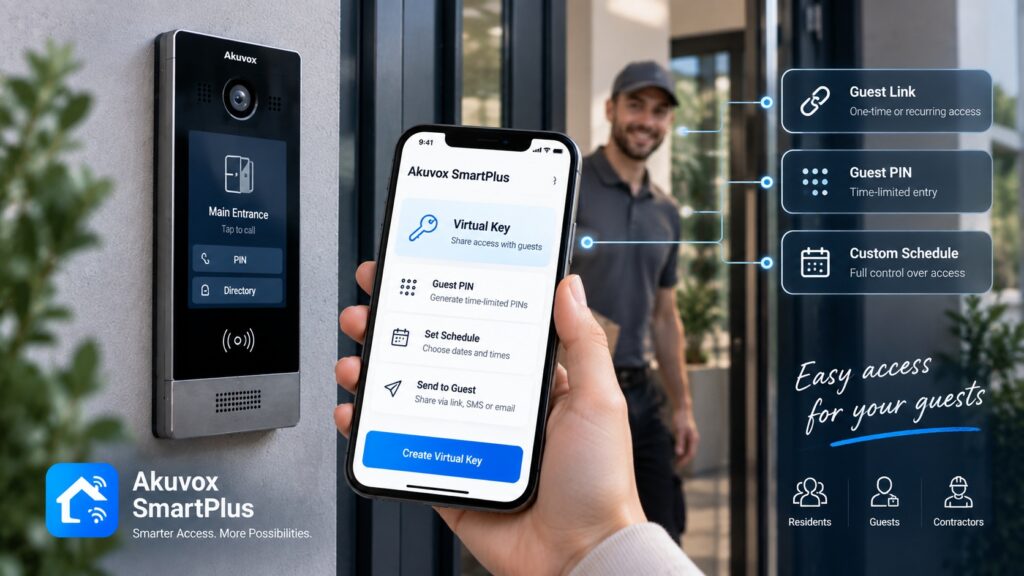
- Guests. Friends and family members can contact the resident through the building entrance. The resident can speak with them before granting access.
- Delivery Personnel. A delivery driver may need to contact a specific resident without receiving a permanent building credential.
- Contractors. Plumbers, electricians, technicians, and other contractors may require temporary access for a specific apartment or building area.
- Service Personnel. Cleaning and maintenance personnel can contact the appropriate resident or building representative when required.
This approach gives residents or property staff an opportunity to verify why someone is requesting entry rather than relying entirely on unrestricted access to the building.
Intercom for Building Staff and Property Managers
Residents are not the only people who interact with an apartment intercom.
Property managers and building staff may need to manage:
- Resident information.
- Apartment assignments.
- Entrance devices.
- Indoor monitors.
- Access credentials.
- Visitor communication.
- Additional entrances.
- System changes when residents move.
A management process becomes particularly important in larger buildings. New residents may need to be added, former residents removed, and devices reassigned.
The exact management capabilities depend on the selected intercom platform. Before installation, property managers should determine who will administer the system and how changes will be handled after the initial installation.
Video Intercom for Apartment Buildings
Video adds visual information to the traditional apartment intercom.
Instead of relying only on the visitor’s voice, the resident can see the person at the entrance through a compatible indoor monitor or mobile device.
This can help residents determine:
- Who is requesting access.
- Whether the visitor is alone.
- Whether the person appears to be a guest, delivery driver, or service provider.
- Whether the person is at the correct entrance.
Video quality depends on the camera, lighting, field of view, and installation position. An entrance that is exposed to strong sunlight, headlights, or poor nighttime lighting may require additional planning.
For this reason, choosing a video intercom is not only a matter of selecting a camera with a particular resolution. The complete entrance environment should be considered.
Smartphone Access for Apartment Residents
Smartphone functionality can be particularly useful in an apartment building because residents are not always inside their units.
A compatible mobile intercom configuration can allow a resident to:
- Receive a visitor call.
- Communicate with the visitor.
- View available video.
- Release the entrance remotely where supported.
For example:
Visitor arrives → resident is away from the apartment → call reaches the smartphone → resident verifies the visitor → entrance is released.
This can be convenient for deliveries and guests when the resident is at work, in another part of the building, or away from home.
The mobile experience depends on the selected equipment, application, network connection, and services enabled for the property.
Managing Multiple Entrances
An apartment building may have several points of entry, and they do not necessarily need identical configurations.
Possible entrances include:
- Main lobby.
- Side entrance.
- Rear entrance.
- Parking entrance.
- Pedestrian entrance.
- Service entrance.
The property manager should determine which entrances require visitor communication and which should be limited to residents or staff.
For example, the main lobby may require a full resident directory, while a service entrance could be intended only for maintenance personnel.
Multiple entrance stations can also create additional management requirements. Users need to understand which calls they receive and which doors they are authorized to release.
Intercom and Access Control for Apartment Buildings
An apartment intercom and an access control system perform different functions.
Intercom = communication with the visitor.
Access control = authorization for entry.
When integrated, the two can work together:
Visitor calls → resident verifies visitor → resident authorizes entry → controlled door is released.
An apartment intercom system with door release in Brooklyn can combine visitor communication with compatible entrance hardware, allowing the resident to release the lobby door after deciding to grant access.
Regular residents can use their assigned access credentials, while visitors can communicate with individual apartments before receiving access.
Depending on the building’s requirements, access control can include:
- Key cards.
- PINs.
- Mobile credentials.
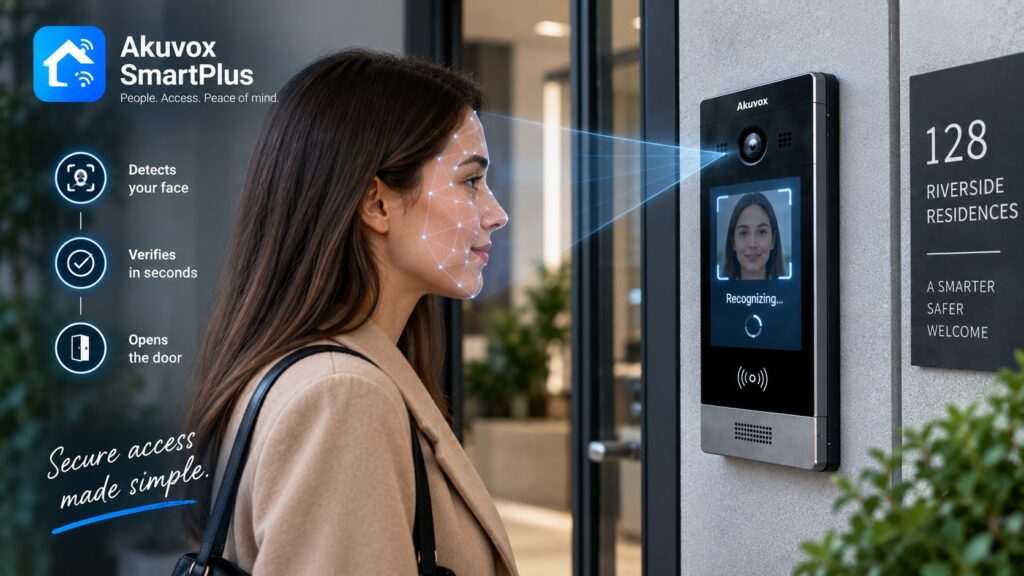
- Facial recognition.
- Controlled common areas.
- Elevator access.
The intercom does not have to replace the building’s access control system. In many projects, it works alongside it as the visitor communication component.
Elevator and Common Area Integration
A modern apartment building can have many controlled spaces beyond the main lobby.
These may include:
- Elevators.
- Parking areas.
- Laundry rooms.
- Storage rooms.
- Fitness facilities.
- Rooftops.
- Community rooms.
- Service areas.
For example, an elevator can require a valid credential before allowing access to particular floors. Common areas can also have separate access requirements.
Integrating these functions can help property managers create a more consistent building access strategy rather than maintaining independent systems for every entrance and shared facility.
The exact capabilities depend on the access control and intercom equipment selected for the project.
Replacing an Old Apartment Intercom System
Many apartment buildings still have older audio intercoms or outdated video systems.
Replacement may be worth considering when residents experience:
- Poor audio quality.
- Damaged handsets.
- Outdated entrance panels.
- No video.
- No smartphone functionality.
- Difficult maintenance.
- Limited access control integration.
- Problems obtaining replacement components.
An intercom system for block of flats in Brooklyn can be planned as a replacement for an older shared entrance system, with the configuration adapted to the number of units and existing building infrastructure.
However, replacing an apartment intercom should not begin with purchasing a new entrance station.
The existing installation should first be reviewed, including:
- Number of apartments.
- Existing entrance stations.
- Indoor units.
- Wiring.
- Door locks.
- Access controllers.
- Network infrastructure.
- Power supply.
- Additional entrances.
Depending on the building, some infrastructure may be reusable while other components may need to be replaced.
Choosing an Intercom System for an Apartment Building
Several factors should be established before selecting equipment.
- Number of Apartments. The system needs to accommodate the number of units and residents who will use it.
- Number of Entrances. Determine how many doors or gates require visitor communication.
- Indoor Devices. Decide whether every apartment should have an indoor monitor or whether mobile communication is sufficient for some users.
- Mobile Access. Determine whether residents should be able to answer calls and release the entrance from smartphones.
- Video. Decide whether visual identification is required at the building entrance.
- Door Release. Identify the existing or planned lock and access-control mechanism.
- Property Management. Establish who will administer residents, devices, and access rights.
- Future Expansion. Consider whether the building may add entrances, common areas, access control, or additional units in the future.
A door intercom system for flats in Brooklyn should therefore be selected according to the number of apartments, entry points, resident requirements, and the building’s existing infrastructure.
The selection process can be summarized as:
Number of units → entrances → resident devices → video → mobile access → door release → management → future expansion
This provides a more reliable basis for choosing equipment than focusing on one feature in isolation.
Akuvox Intercom Solutions for Apartment Buildings
Akuvox offers intercom equipment that can be used to build multi-unit residential communication systems.
Depending on the project, an apartment building configuration can include:
- Multi-tenant doorphones.
- Indoor monitors.
- Video communication.
- SmartPlus mobile functions.
- Access control terminals.
- Multiple entrance stations.
- Elevator access control.
- Property management functions.
The system can be structured around the building’s individual apartments and common areas.
For example, an entrance doorphone can provide the visitor interface, while indoor monitors or compatible mobile applications allow residents to receive calls. Access control equipment can then handle controlled entry.
The exact configuration should be based on the number of apartments, entrance layout, existing infrastructure, and the functions required by residents and property management.
Get an Intercom System for an Apartment Building in Brooklyn
A successful apartment intercom installation starts with understanding how the building operates.
Before selecting equipment, it is useful to establish:
- Number of apartments.
- Number of residents.
- Number of entrances.
- Existing intercom equipment.
- Type of entrance locks.
- Whether video is required.
- Whether residents need smartphone access.
- Whether access control is already installed.
- Whether elevator or common-area access should be integrated.
- Whether the existing wiring can be reused.
Akuvox NYC provides intercom and access control equipment for residential properties in Brooklyn. The appropriate configuration can be selected according to the building’s size, entrance layout, resident requirements, and existing infrastructure.
For a new project or modernization, apartment intercom system installation in Brooklyn should account for both the resident experience and the technical requirements of the building.
Share the details of your property to determine which equipment and configuration may be appropriate.
Request a Quote to discuss an apartment building intercom solution for your property in Brooklyn.
Other Services in BROOKLYN
Other Locations we Serve
FAQ
A visitor uses the entrance station to call a particular apartment or resident. The resident receives the call through an indoor monitor or compatible mobile device, communicates with the visitor, and can release the entrance when appropriate.
Yes. Multi-tenant intercom systems are specifically designed to allow one entrance station to communicate with multiple apartments or residents. The appropriate equipment depends on the number of units and required functions.
Compatible systems can provide mobile intercom functions that allow residents to receive calls and communicate with visitors through a smartphone. Remote entrance release may also be available depending on the configuration.
Yes. A video intercom with a compatible camera and indoor monitor or mobile application can allow residents to view the visitor before releasing the entrance.
Yes. An intercom can be connected to compatible door-release hardware so an authorized resident can release the building entrance after communicating with a visitor.
Yes. A multi-entrance installation can include several entrance stations. The system should be planned around which residents, staff, or property managers need to receive calls from each entrance.
Yes. Intercom and access control can work together. The intercom handles visitor communication, while the access control system manages credentials and controlled entry.
It can be integrated with compatible elevator access control equipment. The exact functionality depends on the selected access control system and elevator controller.
Possibly. It depends on the existing wiring, power supply, entrance hardware, network, and selected replacement equipment. A site assessment can determine which components can be reused and which need to be replaced.
The cost depends on the number of apartments and entrances, doorphone and indoor monitor models, wiring, access control equipment, door hardware, mobile functions, and installation requirements. A project-specific assessment is needed to determine the total cost.
The basic purpose is similar: both allow visitors to contact residents and can support controlled entry. A condo intercom system in Brooklyn may require additional functions for shared amenities, parking, multiple entrances, property management, and other features specific to condominium communities.
How It Works
Consultation & Needs Assessment
We discuss your property, security goals, and operational requirements to understand your specific needs.
Customized Solution Design
Our specialists recommend and design an intercom or access control solution tailored to your home, apartment building, or commercial facility.
Professional Installation
Certified technicians install and configure all system components, ensuring seamless integration and reliable performance.
Ongoing Support & Maintenance
We provide system testing, user training, maintenance, and technical support to keep your solution operating efficiently for years to come.
Get a Quote
Need an access control or intercom system? Tell us about your project and get a tailored solution from Akuvox NYC.
Other Services
Latest Articles